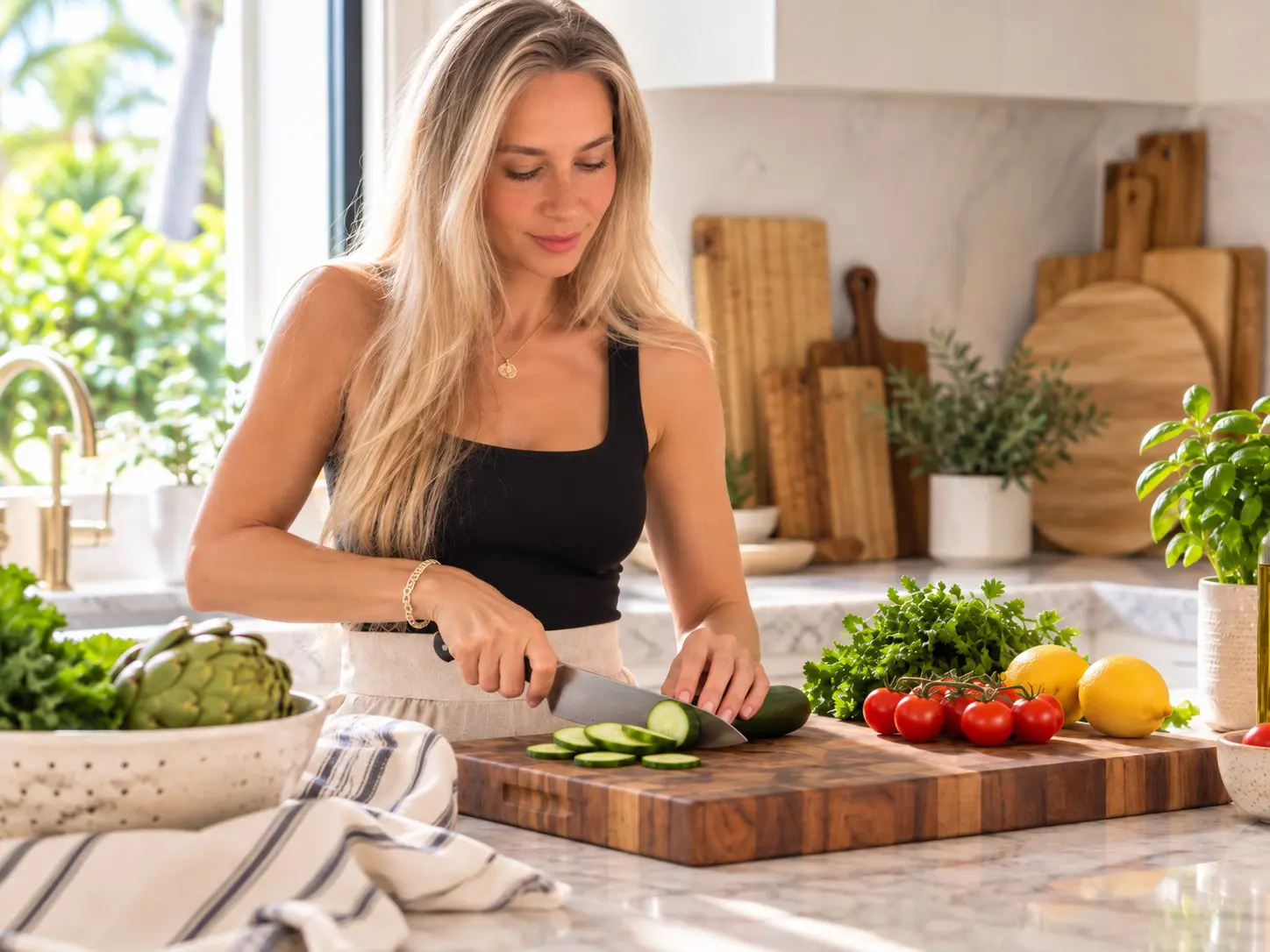
Your knife hits the cutting board a few hundred times before dinner, and whatever the board is made of ends up on the food. A 2023 study estimated that chopping on plastic cutting boards can send up to 50 grams of microplastics a year into what you eat, roughly the weight of ten credit cards. (More on microplastics here.)
The fix is a solid wood cutting board with nothing questionable holding it together. A non toxic cutting board is simply one that doesn’t add harmful chemicals to your food prep, and solid wood, built well, is the easiest way to get there. Below: the materials that qualify as safer options, the seven boards that clear the bar, and the one question to ask about any of them.
Better, not perfect. If your plastic board is on the counter tonight, dinner is fine. You don’t have to make all changes at once, but a cutting board is one of the cheapest kitchen swaps to get right once and forget about for fifteen years.
Quick picks
- Best overall: John Boos CB Series maple. Same build as the two Boos boards in my own kitchen; reversible, juice groove, made in Illinois since 1887.
- Best budget: The Boardsmith Essential maple. FSC maple, made in the USA.
- Best for your knives: The Boardsmith maple end grain. The upgrade from the same shop.
- Best for raw meat and carving: John Boos walnut carving board. Reversible, juice groove, the Amazon sibling of the one in my own kitchen.
- Best no-glue board: JNE hinoki. One piece of Japanese cypress, no finish.
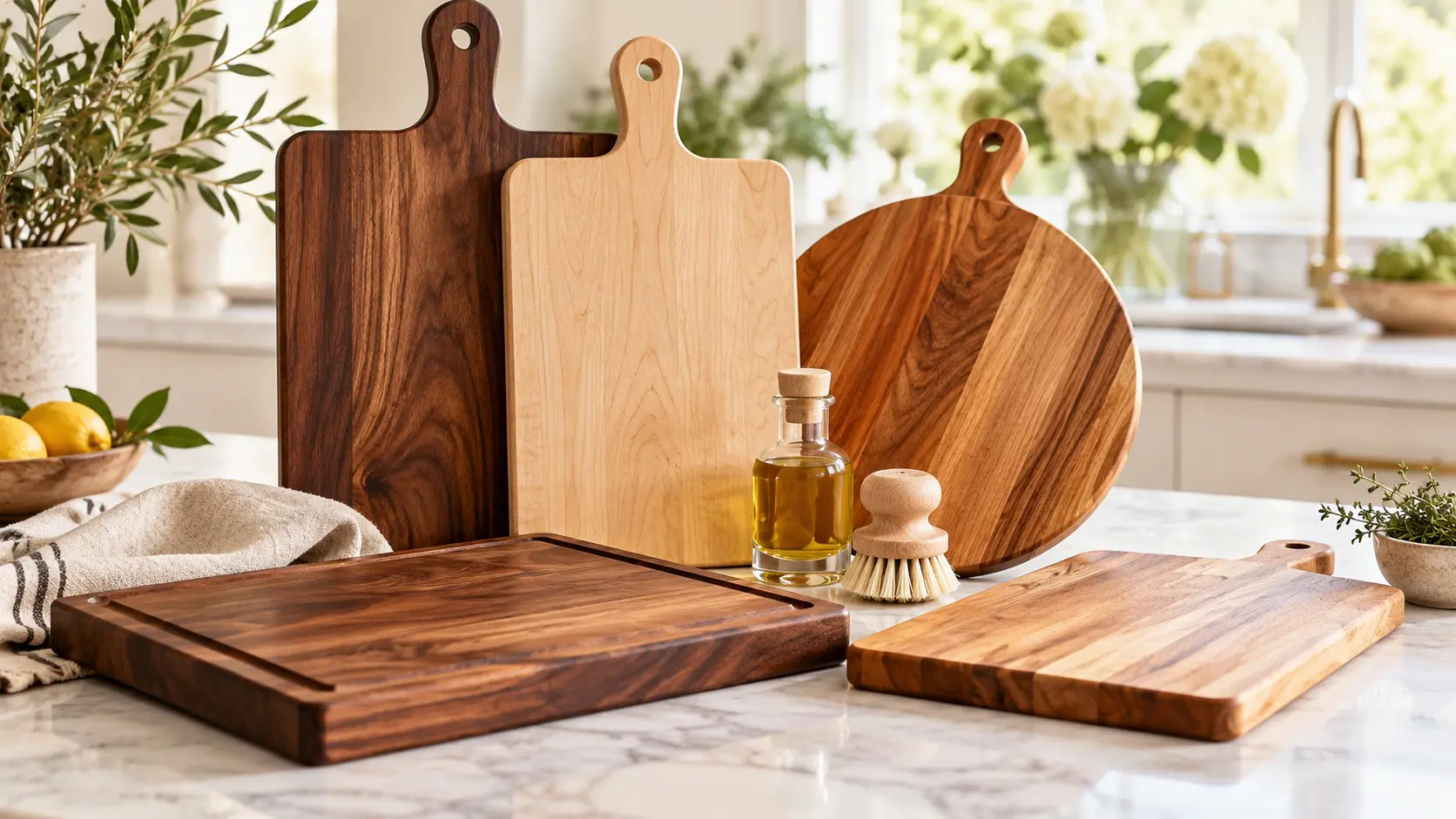
Shop My Cutting Board Favorites
Beautiful wooden cutting boards, food-safe oils, and care essentials—researched for quality, durability, and long-term value. Skip the guesswork and shop my curated Amazon collection!
As an Amazon Associate, I earn from qualifying purchases.
What makes a cutting board non toxic
Two questions: what is the surface made of, and what holds it together? The first one gets all the attention; the second has a reassuring answer.
Plastic, bamboo, and metal boards
Plastic cutting boards fail the first question; they scar, the scars absorb bacteria, and the shavings go in the food. You’ll also see claims that food-grade HDPE minimizes shedding. However, polyethylene was one of the two plastics tested in the 2023 study, and it shed.
Bamboo is dense, durable, and moisture-resistant, but a bamboo board is dozens of thin strips glued together, and the cheap ones use formaldehyde resins. A bamboo maker that names a food-safe adhesive is worth buying from; most don’t. Meanwhile, a titanium board, stainless steel, or glass is non porous and dishwasher safe, but all three dull knives faster than anything else. My family and I love cooking together; we like to keep all of our knives in perfect shape.
Why solid wood wins
Solid wood answers both questions, and the research agrees. A 1994 study found bacteria became undetectable on wood while surviving on plastic, and a 2025 study found E. coli dropped to the detection limit on maple within two hours. That’s because the fibers and natural tannins in hardwood pull moisture away from the surface, so the bacteria dry out. For the same reason, the FDA permits hard, close-grained hardwoods like maple and walnut as food contact surfaces: they resist the deep scarring where bacteria can grow.
What about the glue?
The second question, what holds the board together, is good news. Any edge grain or end grain board is made of wood rails glued side by side, and the glue in a well-made board is a cured wood glue such as Titebond III, which is inert once dry and FDA-approved for food-contact use. The glue lines are a fraction of a millimeter thick and run through the board rather than across the surface, so a knife crosses them without cutting into them; one maker’s math puts the total glue a knife could ever touch at about a grain of salt. The adhesive to avoid is the formaldehyde resin in cheap laminated bamboo, which is why every board below is solid hardwood or hinoki, and why a maker that names its glue earns a mention.
Material | Gentle on knives? | What’s in it | Dishwasher safe? | Verdict |
|---|---|---|---|---|
Solid wood (maple, walnut, teak) | Yes | Wood, plus glue unless one piece | No | Best everyday board |
Hinoki | Very | Wood, unfinished | No | Best for fine knives |
Bamboo | Fair | Strips + undisclosed adhesive | No | Only if the surface is glue-free |
Plastic (HDPE, PP) | Yes | Plastic that sheds into food | Yes | Replace it |
Rubber / paper composite | Yes / Fair | Synthetic polymers or resin, not published | Varies | Skip |
Titanium, steel, glass | No | Metal or glass | Yes | Serving or raw meat only |
Every board below is solid hardwood or hinoki, and each entry lists what it’s made of, how it’s built, and what holds it together.
How these 7 non toxic cutting boards were chosen
- Solid hardwood or hinoki. No composites, no coatings.
- Solid rails, food-safe glue. One-piece boards have no glue at all; glued boards should use a cured wood glue like Titebond III. Makers that name theirs get credit for it.
- A simple finish. Mineral oil and beeswax, a plant oil, or nothing. No varnish, no “antimicrobial” treatment.
- Experience. I have heavily researched and/or tried all of these boards
The 7 best non-toxic cutting boards
1. The Boardsmith Essential Hard Maple — best budget
Wood / build: FSC-certified hard maple, edge grain, 16×10×1″
Adhesive: Titebond III, named by the maker
Finish / origin: Mineral oil and beeswax; Frisco, Texas, USA

Who it’s for: anyone replacing a plastic board on a budget. It’s the entry-level board from the shop that makes the end grain block below, built to the same standard at a quarter of the price.
What you get: a solid maple wood board with smoothly rounded edges that fits beside the sink and gets used for the apple and the half onion, which is what a cutting board is actually for most days. It’s a medium-size board, so it takes up little counter space and stores in a cabinet if you’d rather not leave it out. Hard enough to shrug off years of chopping, light enough in color to show you when it needs a wash, finished with nothing but mineral oil and beeswax.
The difference from the $20 boards next to it: certified wood, a US shop, and a maker that tells you exactly what’s in the board, down to the glue.
The honest downside: it’s an inch thick, so it’s a prep board rather than a butcher block, and it will show knife marks sooner than a thick butcher block. A damp towel underneath keeps it from sliding on a stone counter.
2. John Boos CB Series Maple, 24×18 — best overall (my favorite)
Wood / build: Northern hard rock maple, edge grain, reversible, 1½” thick, juice groove, finger grips
Adhesive: NSF certified for food contact
Finish / origin: Boos Board Cream (beeswax and mineral oil); Effingham, Illinois, USA

Who it’s for: the cook who preps whole meals at once and is tired of moving piles of chopped vegetables off the board to make room to slice the next thing. A 24×18 surface is what restaurant lines use.
What you get: the same Boos construction that’s been made in Illinois since 1887, in its most generous size. One side has a juice groove for roasts, tomatoes, and anything that runs; the other is flat for everyday chopping, and it’s handsome enough to serve from. As a result, you can keep one face for raw meat and the other for everything else, which is the USDA’s own recommendation. NSF certified, finger grips for carrying, and Boos’s Board Cream is unbleached beeswax and mineral oil with nothing added.
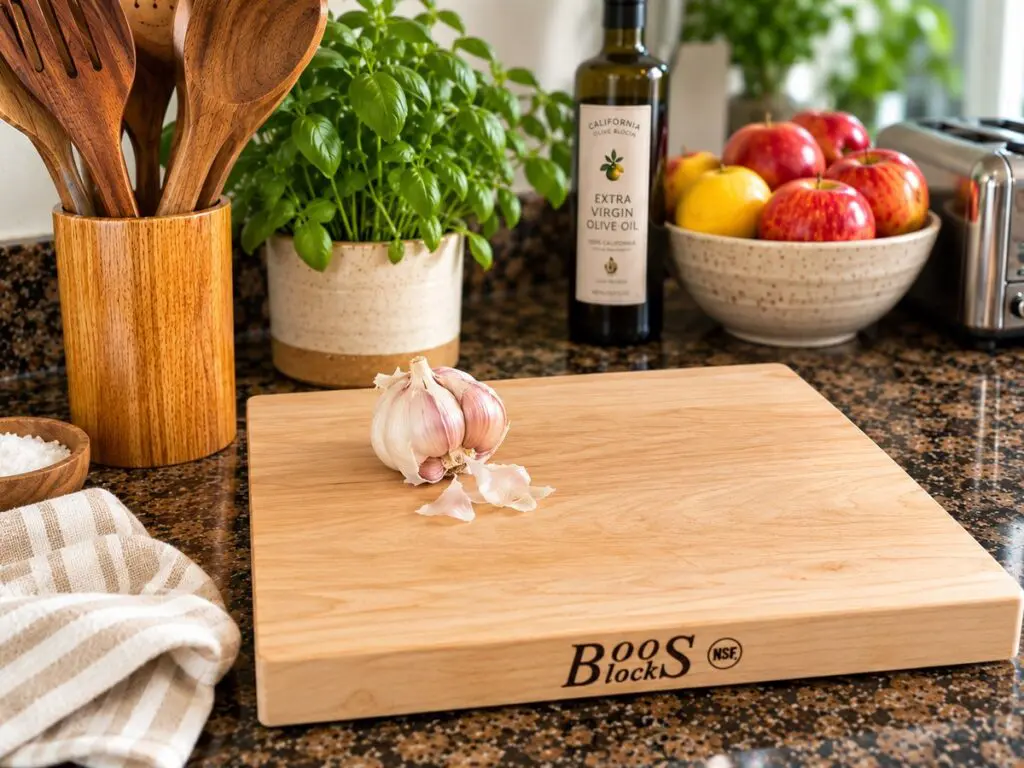
Maple is the same wood as one of the two Boos boards in my own kitchen, and it has held up.
The honest downside: after a few years with two Boos boards, I don’t have one for the build. The only question is size: the 24×18 is more board than a small kitchen needs, and the 20×15 and 18×12 are the same construction in a footprint that fits a drawer.
3. The Boardsmith Maple End Grain — best for your knives
Wood / build: FSC-certified hard rock maple, end grain, 2″ thick, non-slip feet
Adhesive: Titebond III, named by the maker
Finish / origin: Oil and Board Butter; Frisco, Texas, USA

Who it’s for: anyone who cooks most nights and owns knives worth sharpening. This is the board that protects the edge and makes sharpening happen less often.
What you get: the construction chefs prefer: the knife slips between the wood fibers instead of cutting across them, so the edge stays sharp longer and the surface self-heals after chopping instead of staying scored. The Boardsmith builds it from unusually large 4″ blocks, which means fewer glue joints than the checkerboard boards you’ll see elsewhere, and it comes with non-slip feet installed so a sturdy two-inch slab of maple doesn’t move under a heavy cleaver. Forbes named it the best upgrade pick in its wooden cutting board test, and the build quality is the difference between a board you replace and one you refinish. The Boardsmith is also the maker whose grain-of-salt math on glue exposure is cited above; they publish it because they’re proud of the joinery.
The honest downside: the weight, the lead time, and the price. So buy direct if you can; the Amazon listing is a third-party seller and runs well above the shop price. If you want the construction in a small cutting board, the 9×12 Sidekick is the same thing at a size that lives on a shelf.
4. Sonder Los Angeles Alfred Walnut End Grain — best countertop board
Wood / build: American black walnut, end grain, 17×13×1.5″, juice groove, three sorting wells, removable feet
Adhesive: Not named; maker states formaldehyde-free
Finish / origin: Mineral oil and beeswax; handcrafted in small batches in the USA

Who it’s for: the kitchen where the board stays out and has to look like it belongs. Walnut is the wood for that: the dark grain hides the stains a maple board shows and gets richer with oiling.
What you get: a 7.5-pound walnut butcher block that’s kinder to a knife edge than maple because walnut is a little softer, with a juice groove on one face and three carved wells on the other for sorted prep, or for olives and crackers on a cheese night. The feet come off when you want it flat, and it arrives in a gift box, which tells you what Sonder thinks its job is. Sonder also states the board is formaldehyde-free, which is more than most makers say.
The honest downside: because walnut is softer, deep cuts arrive sooner than on maple, even though the dark grain keeps them from showing, and Sonder asks for oil every two to three weeks rather than monthly, so it’s a little more upkeep. (“Free of BPA and phthalates” on a wooden board is true but beside the point; those are plastic chemicals it never contained.)
5. JNE Hinoki — best no-glue board, and the lightest
Wood / build: Hinoki (Japanese cypress), one solid piece, no joints
Adhesive: None
Finish / origin: Unfinished; Japan

Who it’s for: Japanese knife owners, small kitchens, and anyone who wants the simplest possible answer to “what’s in it.” One piece of wood with nothing on it; the only board here that can say that.
What you get: the one softwood here, and that’s the point. Hinoki has a little give under the blade, which is why it’s the traditional board for Japanese cutlery, and shallow cuts close back up when the fibers swell after washing. It’s lightweight, smells faintly of lemon and cedar, and is naturally resistant to fungus, which is why the same wood is used for Japanese baths. The routine is simple: wet the surface before you cut so it doesn’t stain or absorb odors, wash with mild soap, and store it standing up to dry.
The honest downside: a cleaver or a serrated bread knife will leave real marks. Also, it must dry upright. Left flat on a wet counter, it will warp.
6. Teakhaus End Grain Teak — best for humid kitchens
Wood / build: FSC-certified plantation teak, end grain; Medium linked here, Large is 20×15
Adhesive: Not named
Finish: Mineral oil and beeswax, no synthetic coatings
Who it’s for: humid kitchens, and anyone whose first filter is where the wood came from.
What you get: teak is naturally oily, which is why it’s used on boat decks, and that same oil is why this board shrugs off moisture and warping that would move a maple board in a humid climate. It’s a generous self-healing surface at a price that undercuts every comparable board here, with a 20×15 Large if you want more room. Teakhaus grows the wood on certified plantations rather than cutting old-growth forest, says its production is zero-waste, and has won an FSC leadership award for it, which is about as good as a wood board gets for the environment.
The honest downside: teak contains silica, which makes it a bit harder on an edge than maple or walnut, so it asks a little more of your sharpener.

7. John Boos Walnut Edge-Grain Cutting & Carving Board — best for raw meat and carving
Wood / build: American black walnut, edge grain, reversible, 1½” thick, juice groove on one side, finger grips
Adhesive: Not named; NSF certified for food contact
Finish / origin: Boos Board Cream; Effingham, Illinois, USA

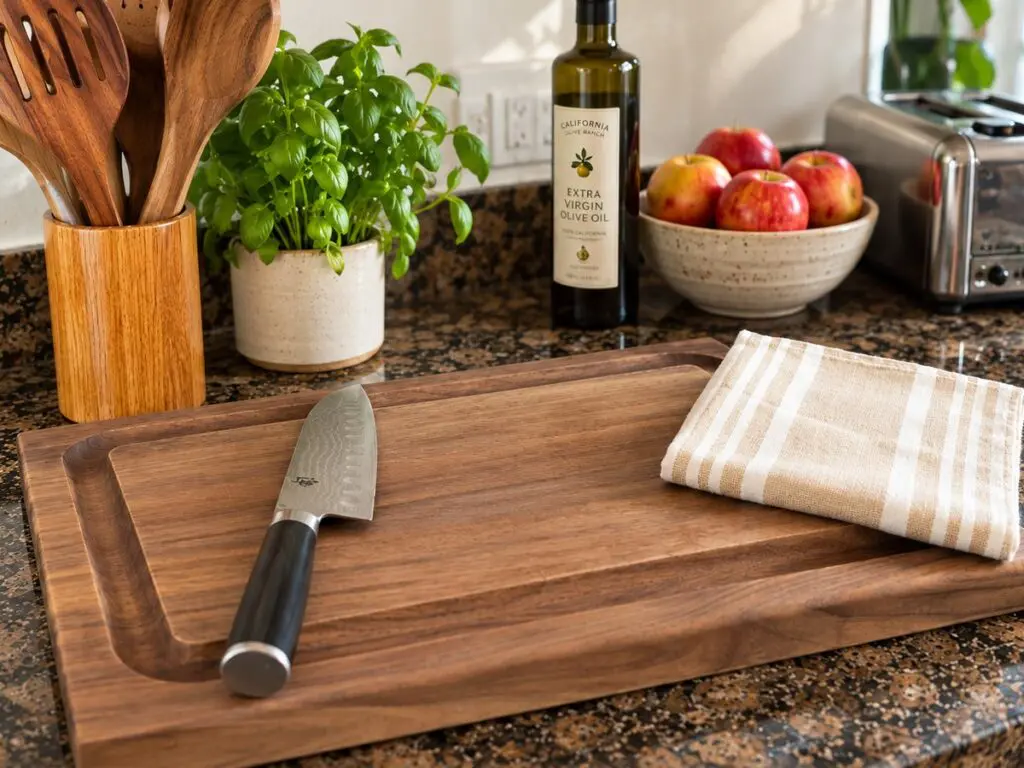
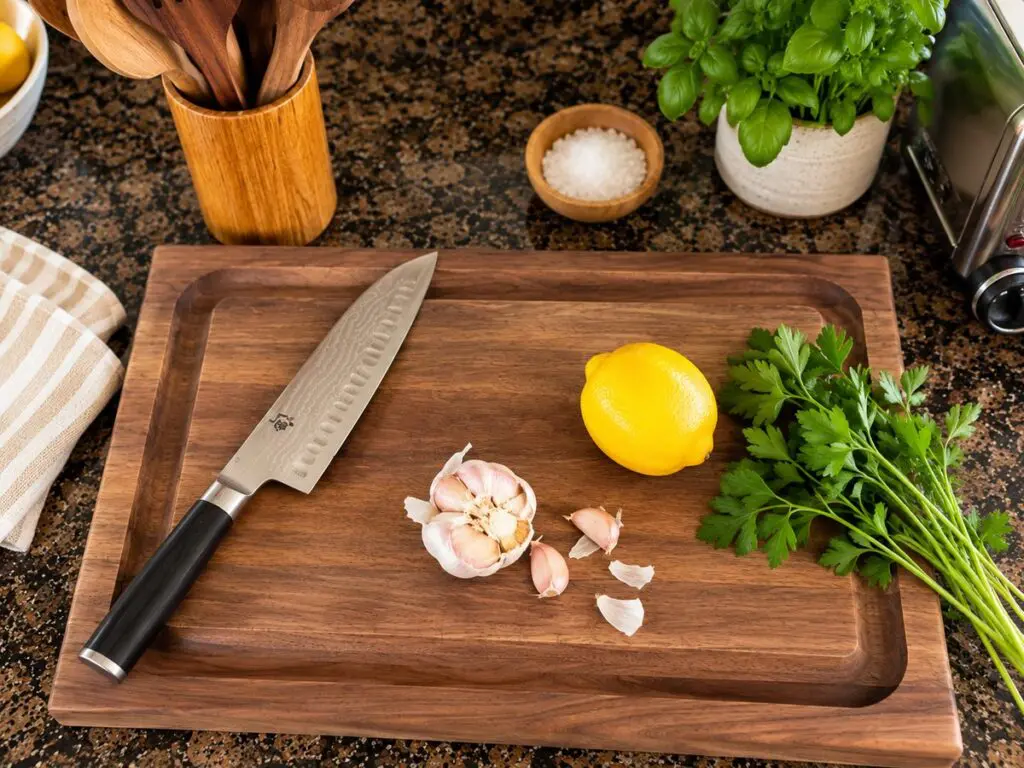
Who it’s for: the cook who roasts, grills, and carves, and wants one board that keeps raw meat separate without buying two. I own two Boos boards, this walnut and its maple counterpart, and I love both; they live in a large drawer and come out for nearly every meal. Mine is the 20×15 edge-grain cutting and carving board from Williams Sonoma, which isn’t sold on Amazon, so the board linked here is its closest sibling: the 18×12 BBQ Series, same walnut, same edge-grain build, same Effingham factory, with a juice groove and a reversible face, at about half the Williams Sonoma price.
What you get: Boos calls it a BBQ board, which undersells it. The groove side catches what runs off a roast chicken or a pile of tomatoes before it reaches the counter; the flat side is the everyday chopping surface. Reversible means one face for raw meat and one for everything else, which is exactly what the USDA recommends for avoiding cross-contamination. The walnut hides stains the way the Sonder does at a lower price, and the finger grips make it easy to carry to the sink. NSF certified.
The honest downside: walnut shows deep cuts a little sooner than maple, and the 18×12 is on the small side for carving a large roast; step up to the 17×21 if that’s the main job.
Raw meat, the dishwasher, and oiling
Once you’ve picked a board, here’s how to clean a wooden cutting board so it lasts.
Is a wooden cutting board safe for raw meat?
Yes. The USDA says wood and non porous boards both work for raw meat and poultry, and recommends a separate board for raw protein to avoid cross-contamination; a reversible board handles that. Wash with hot soapy water and a non-abrasive sponge right after, and stand it up to dry. Maintenance is most of the hygiene story with wood: a clean, dry, oiled board is the one the studies describe.
Can you put it in the dishwasher?
No, because heat and a drying cycle pull moisture out unevenly, which means warping, splitting, and eventually a board that breaks along the grain. The only dishwasher safe boards are metal, glass, and composites, and those cost you knife edges or put a resin under the food.
How often does it need oil?
About once a month: food-grade mineral oil, with board wax applied after to seal it, or walnut oil and beeswax if you’d rather skip petroleum. Between oilings, store the board vertically so that both faces dry and it doesn’t warp. Wood is naturally odor resistant; to get rid of garlic and onion smell, scrub with coarse salt and half a lemon. When the surface feels rough or looks pale, it’s asking for oil. When it’s scarred, sand it smooth and oil it again; a wooden board doesn’t wear out, it gets refinished.
Which one to buy
In short, for most kitchens the John Boos CB Series maple is the non toxic cutting board to buy. I own two Boos boards, a maple and a walnut, and after a few years of daily use the only decision I’d make differently is which size fits the drawer. If budget comes first, the Boardsmith Essential gets you certified wood and a named glue for the price of a few plastic boards. If you cook most nights and own knives you care about, the Boardsmith end grain block is the upgrade that will still be on your counter in 2050. From there, the non-toxic cookware guide and the free plastic-free kitchen swaps checklist pick up where the cutting board leaves off.
Sources
- Yadav, H. et al. (2023). Cutting Boards: An Overlooked Source of Microplastics in Human Food? Environmental Science & Technology.
- Ak, N.O., Cliver, D.O., Kaspar, C.W. (1994). Cutting Boards of Plastic and Wood Contaminated Experimentally with Bacteria. Journal of Food Protection.
- Kamdem, D.P., McIntosh, D., Sinha, A. (2025). Survival of Escherichia coli on Sugar Maple and High-Density Polyethylene Cutting Boards. Journal of Food Protection.
- USDA Food Safety and Inspection Service. Cutting Boards.
- The Boardsmith. About Joinery and Making a Cutting Board.
- About the Author
- Latest Posts
- How I Test and Recommend

Juliet is the creator of Living Wild & Green, where she researches and writes about eco-friendly living, sustainable fashion, and non-toxic home upgrades. Since 2020, she’s been curating science-backed, stylish sustainability tips and personally testing products to help thousands of readers cut through greenwashing and live greener with confidence.