
This site contains affiliate links. I earn a commission if you make a purchase, at no additional cost to you 🙂
Laundry is one of those rooms where a few simple swaps can make a surprisingly big difference. Over the years, I’ve gradually replaced dryer sheets, fabric softener, plastic-heavy products, and other things I no longer wanted in my routine.
This list includes the 14 non-toxic laundry products I actually use in my own laundry room, from detergent and stain remover to drying racks, brushes, and storage. Some help cut down on plastic, some replace harsher products, and some just make laundry easier.
I’ll tell you what I like about each one, what I don’t, and where I think it’s actually worth spending your money. Because not every “eco-friendly” laundry product is better, and you definitely don’t need to replace everything you own just because the internet told you to.
One rule before the list
I don’t treat packaging I can see and recycle as a dealbreaker. A cardboard box, a metal tin, a paper bag: fine. What I won’t put in a post with “non-toxic” in the title is plastic inside the product.
That’s why you won’t find laundry sheets or pods here, even though I’ve used both. They’re held together with PVA (polyvinyl alcohol), a synthetic polymer that dissolves in your wash water. The cleaning industry says it fully biodegrades at the treatment plant; some researchers have questioned how completely that happens under real-world wastewater conditions. Until that’s settled, I’m not calling a sheet plastic-free, and I’d be cautious of anyone who does. The longer version of how I evaluate claims like that is in my post on how to spot greenwashing.
The other thing I look at is packaging. A conventional laundry detergent jug is plastic packaging used once, and across a year of dirty loads that adds up to real plastic waste. Cardboard packaging, a compostable box, or a refill pouch that replaces five spray bottles is how you eliminate plastic from this room without changing how you wash clothes. Concentrated formulas help too: less water shipped means a smaller carbon footprint per load.
One more thing, and it’s true of everything on this site: I’m not the eco police. The goal is better and doable, not perfect. If something replaces plastic, cuts waste, and lasts, it’s in, even if a purist could find a flaw. The one thing I won’t recommend is anything toxic.
Non-toxic laundry essentials: the swaps that cut toxins, plastic, and waste
1. Wool dryer balls
Six extra-large balls of felted New Zealand wool, no synthetic filler. They replaced dryer sheets and fabric softener in one go. Tossed in with a load, they keep clothes separated so air moves through, which shortens drying time on towels and sheets, and they soften fabrics by tumbling against them instead of coating them in a chemical film. That film is why towels stop absorbing water after a few months of softener. Without it, they work like towels again.
They come unscented, and some people miss the fresh linen smell. A lot of people add a couple of drops of essential oil to each ball for a fresh scent that actually comes from a plant. If you do, let the balls dry completely before they go back in the dryer, both so the oil doesn’t spot light fabrics and because you don’t want wet oil in a heated appliance. They’re rated for over a thousand loads, so a set lasts years. And yes, they thump a little in the dryer. You stop hearing it after the first week.
Best for: anyone still buying dryer sheets. Easiest swap on the list.
Skip if: you want a strong laundry scent and don’t want to bother with oils.

Natural Wool Dryer Balls | Reusable Natural Fabric Softener | Reduces Wrinkles & Drying Time
2. Molly’s Suds laundry powder
This is the natural laundry detergent I keep coming back to. The ingredient list is short: plant-derived surfactants and natural enzymes, dye free, no synthetic fragrances, with a fragrance-free option if you’d rather have nothing at all. It’s Leaping Bunny certified cruelty free, septic safe, and the formula is biodegradable. A pediatric nurse created it after losing her daughter and going looking for what was in conventional detergent, and that focus still shows in what’s left out.
Cleaning power on everyday dirty loads is right there with the conventional detergents I used before, and there’s no sticky liquid cup to rinse. It’s ultra concentrated and low-sudsing, so it works in HE washing machines without an extra rinse, and clothes come out smelling clean rather than perfumed. The lavender version is lightly scented from essential oil and fades by the time things are dry.
The one quirk of powder: it needs to dissolve. On a cold, short rinse cycle it sometimes doesn’t fully. Warm water or a longer cycle fixes that, or you can dissolve a scoop in a cup of hot water first for a heavily soiled load.
Best for: sensitive skin, and anyone who wants a detergent with an ingredient list they can read.
Skip if: you only ever wash on cold, quick cycles. Liquid dissolves more reliably there.
I compare the detergents I’ve used, with EWG scores, in a separate post on non-toxic laundry detergents.

3. Miss Mouth’s Messy Eater non-toxic stain remover (refill)
An EPA Safer Choice certified stain remover that’s pH neutral and free of peroxide, chlorine, phosphates, parabens, and fragrance. It was made for baby food and formula, which is a tougher category than most of what adults get on themselves, and it shows. Fresh food, grease, and berry stains come out with a spray, a light rub, and a normal wash. Tough stains that have set usually come out too, though stubborn ones sometimes take a second round.
Two things to know. It’s a stain product, not an odor remover; for smell, the oxygen bleach further down does that job. And it can lighten some dark dyes if it sits too long before washing, so treat and wash within an hour on darks.
I link to the 16-ounce refill pouch rather than the spray bottle. I get those glass refillable bottles and keep refilling it. Same product, a lot less plastic.
Best for: kids, pets, and anyone who eats over a laptop.
Skip if: your main problem is sweat and oil on collars. The oxygen bleach handles those better.

4. Puracy laundry stain brush
A solid beechwood brush with vegan bristles, plant-based per the maker, cut to 1.15 inches. Puracy designed it to work with their own stain spray, but it does the same job with any stain remover, and it’s the step most people skip. Stain remover works by getting into the fibers, and rubbing it in with your thumb doesn’t do that. An old toothbrush does, but stiff nylon pills the fabric. These bristles are firm enough to work the remover in and soft enough not to fuzz cotton or linen, and the handle is shaped so you get real leverage on a collar without cramping your hand.
Spray, brush for ten or fifteen seconds with just the weight of your hand, let it sit, then wash. The handle isn’t sealed, so keep it dry between uses. Puracy rates it for over a thousand stain treatments, which is a lot of collars.
Best for: anyone who owns a stain spray and wonders why it doesn’t work better.
Skip if: you already have a soft natural-fiber brush you like. This isn’t a second one.

5. AspenClean oxygen bleach: a non-toxic bleach alternative
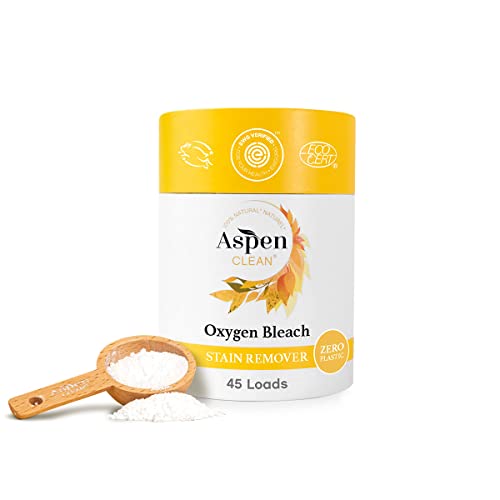
An unscented oxygen bleach powder, sometimes sold as an oxygen brightener, that’s EWG Verified, Ecocert certified, Leaping Bunny certified, made in the USA, and packed in a compostable container with no plastic anywhere. Oxygen bleach is sodium percarbonate, which releases hydrogen peroxide in water. It replaced chlorine bleach in my house and I haven’t missed it.
A tablespoon in the drum before the clothes brightens whites and lifts the grey out of towels that have seen too much hard water, and it’s generally color-safe when used as directed; check the care label on anything delicate or not colorfast. Mixed into a paste with warm water, it’s the best thing I’ve found for sweat stains on collars and underarms, and for odor removal on gym clothes it does more than baking soda ever did for me. No chlorine, none of the fumes, no cracking a window. If I could keep only one product on this list, it would be this one.
It works best in warm or hot water and is noticeably weaker in cold. Forty-five loads per container is accurate at a tablespoon a load. Keep the lid on; it clumps in a humid room.
Best for: white sheets, towels, and anyone whose laundry room used to smell like a pool.
Skip if: you wash exclusively in cold water and won’t change that.
6. Horsehair lint brush
A ten-inch brush with 100% horsehair bristles and a solid walnut handle. Both materials are stated outright on the listing, which is rarer than it should be for a brush. It replaced lint rollers, which are a plastic handle plus adhesive sheets you throw away, and it will outlast every roller I would have bought.
Horsehair is soft enough for cashmere and wool and firm enough to lift lint, dust, and pet hair off a coat in a few strokes. The bigger payoff is that brushing a sweater between wears means it goes three or four wears before it needs a wash, and fewer washes is the kindest thing you can do for wool.
It moves hair rather than picking it up, so brush downward and off the garment. On fine pet hair embedded in fleece, a roller still wins. And because it’s a generic listing, check that the bristles still say horsehair when you buy.
Best for: wool, cashmere, dark coats, and pet owners.
Skip if: your lint problem is mostly fleece and fine dog hair.

Non-toxic laundry room must-haves for a sustainable setup
7. Cotton mesh laundry bags
Six zippered cotton mesh bags in graduated sizes. Bras, delicates, and socks go in these. The zipper has a small cover so it doesn’t snag anything in the drum, the mesh is fine enough that a bra hook can’t poke through, and socks stop disappearing. They dry fast on the rack.
One thing they don’t do is catch microfibers. Cotton mesh protects your clothes; it doesn’t trap what synthetics shed. If that’s what you’re after, it’s a different product, and I cover it in my post on microplastics in daily life. The listing says organic cotton; I couldn’t find a GOTS certification, so I’m calling it cotton. If certified organic matters to you, look for that mark.
Best for: anyone who has lost a sock or stretched a bra in the wash.
Skip if: you’re buying it for microfiber capture. It isn’t that.

8. Cotton rope laundry basket
A big basket, 24 by 16 by 14 inches, woven from cotton rope with reinforced handles and a braided finish inside so it holds its shape. This is the hamper. It takes a full family load, the handles don’t dig into your fingers, and it looks fine sitting in a bedroom. No plastic edges to crack, no lid to lose. It arrives folded and takes a day to relax.
It’s spot-clean only, so it’s not the basket for wet towels or a muddy uniform. And like the mesh bags, it says organic without a certification I could find. Cotton rope is enough.
Best for: a hamper that can live in plain sight.
Skip if: you need something you can hose out.

9. Water hyacinth storage baskets
A set of three, handwoven by artisan groups in Vietnam, with built-in handles. Water hyacinth grows fast, so it’s a genuinely renewable fiber. These sit on the shelf above the washer and hold the dryer balls, both brushes, the mesh bags, and the clothespins. The weave is tight, the handles are solid, and they look like something from a market rather than a warehouse. New, they have a faint grassy smell that fades in a week.
They’re indoor only and they don’t like moisture. In a humid laundry room, keep them on a shelf, not the floor, and don’t put anything damp in them. Handmade means the three won’t be perfectly identical.
Best for: open shelving where you’d rather see baskets than bins.
Skip if: your laundry room is a damp basement.

10. Metal laundry container
A metal canister with a wooden lid handle and a scoop, plus a smaller metal holder. It’s sold for pods and dryer sheets. I use neither, so the canister holds my laundry powder with the scoop hung on the handle and the small one holds clothespins. It’s the fix for a torn powder bag on the shelf, and the lid seals well enough to keep humidity out, which matters for powder.
It’s not for liquid detergent, and it’s painted metal, so don’t leave it somewhere it stays wet.
Best for: powder detergent that’s already out of the bag.
Skip if: you use liquid, or you don’t care what the shelf looks like.

11. Wall-mounted folding drying rack
Two small acacia wood racks that screw into the wall and fold flat. Two screws each, five minutes with a drill. One holds bras and anything with elastic that shouldn’t see a dryer; the other takes whatever is hang-dry only. Folded, you forget they’re there, and the acacia grain is nice enough that they read as a design choice rather than a fixture.
They’re small, a handful of hangers each, not a full load. They also need a stud or a proper anchor; drywall alone won’t hold a wet coat.
Best for: small laundry rooms and weekly delicates.
Skip if: you want one rack for everything. That’s the tripod below.

12. Beech wood tripod drying rack
A collapsible tripod in solid beech with sixteen poles, plus two spares, that folds into a bundle you can slide behind a door. The umbrella shape is the point: clothes hang around the outside with air on all sides, so they dry faster than on a flat accordion rack, and a full set of towels and sheets fits. It’s stable under a load of wet bath towels, and the beech is smooth enough not to snag knits.
Sixteen poles means sixteen things to fit back into the bundle, and it takes a minute the first few times. Wood absorbs water, so let it dry and fold it up rather than leaving it standing in a damp room for days. The seller is a generic marketplace brand, so the listing could change.
Best for: anyone ready to stop running the dryer for towels and sheets.
Skip if: you have nowhere to put a four-foot rack, even folded.

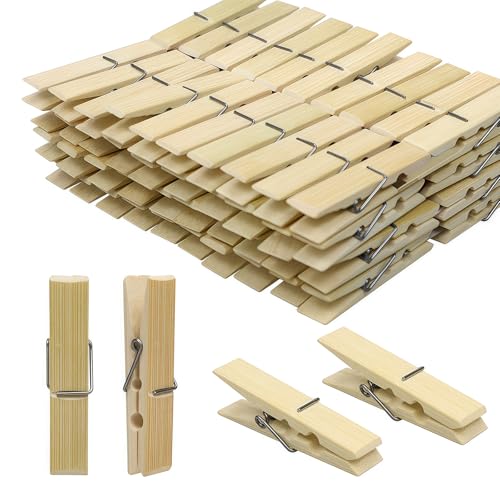
13. Bamboo clothespins
Twenty bamboo pins, 2.4 inches, with rust-resistant springs. They grip. The spring is stiffer than the pine ones from the hardware store, which is what you want holding a wet towel on a rack, and bamboo doesn’t split in the sun the way pine does or crack the way plastic does.
Twenty isn’t many for a full load; get two packs. And bamboo can leave a faint mark on white fabric if it’s soaking wet and left for days. It washes out.
Best for: the drying rack above. You’ll need them.
Skip if: you don’t air-dry.
14. Red cedar hangers
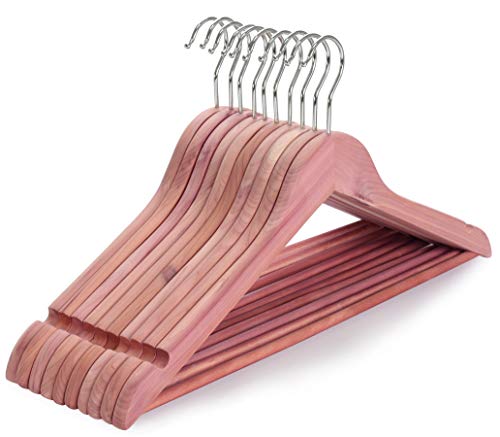
Ten hangers in unfinished American red cedar, no paint or coating, with a 360-degree chrome hook, sanded notches for straps, and a solid pant bar. About two dollars a hanger. The scent comes from the wood’s own oils, and cedar does two jobs in a closet: it repels moths and it absorbs moisture. In a humid climate the second one matters more, and this is where my wool and linen live.
The shoulders are contoured so jackets hold their shape, and the notches actually hold a camisole strap. The scent is subtle to begin with and fades over a year or two; a light sanding brings it back. They’re slim, not wide-shoulder, so a heavy winter coat is better on something broader.
Best for: wool, linen, and anything you’d hate to find a moth hole in.
Skip if: you need wide shoulders for coats, or you’re expecting a strong cedar smell.
The swap list at a glance
Instead of | Try this |
|---|---|
Dryer sheets | Wool dryer balls |
Liquid fabric softener | Wool dryer balls (same ones) |
Conventional detergent | Molly’s Suds powder |
Laundry sheets or pods | Powder, until the PVA question is settled |
Chlorine bleach | Oxygen bleach |
Stain spray in a new bottle every time | One bottle, refill pouch |
Old toothbrush for stains | Plant-bristle stain brush |
Lint rollers | Horsehair brush |
Running the dryer for everything | Tripod rack for towels and sheets, wall rack for delicates |
Plastic clothespins | Bamboo |
Plastic or velvet hangers | Unfinished cedar |
Plastic hamper and bins | Cotton rope and water hyacinth |
Does any of it save money?
Two of the best non-toxic laundry products on this list pay for everything else: the dryer balls and the drying rack. Dryer sheets run twenty to forty dollars a year and the balls last three or more. The dryer number is an estimate, because electricity prices and dryer efficiency vary a lot, but at U.S. averages a cycle costs somewhere around fifty to seventy cents, so air-drying three loads a week lands roughly a hundred dollars a year. The rest is a wash financially. The baskets, bags, and container are organization, not savings, and I’d rather say that than pretend a basket pays for itself.
Questions I get about non-toxic laundry products
What should a non-toxic laundry detergent leave out?
Mostly what gets added, not the soap itself. The short list I check against: optical brighteners (dyes that stay on fabric and aren’t readily biodegradable), synthetic fragrances (one word that can cover thousands of ingredients the maker doesn’t have to name), artificial dyes, formaldehyde-releasing preservatives, and chlorine. If you have sensitive skin, sodium lauryl sulfate and sodium laureth sulfate are worth avoiding too. The rest of the ingredient conversation, including ethoxylates, benzisothiazolinone, and the palm-oil question, is in my non-toxic laundry detergents post.
Which certifications actually mean something?
Independent ones. A brand can print “non-toxic” on its own label; it can’t award itself these:
- EWG Verified means the Environmental Working Group reviewed the full formula, including fragrance, against its strictest standard. AspenClean carries it.
- EPA Safer Choice means every ingredient was reviewed by the EPA for human and environmental safety. Miss Mouth’s carries it; so do Blueland’s laundry tablets.
- Made Safe screens for known toxic ingredients across the whole product. Meliora’s laundry powder carries it.
- USDA Certified Biobased verifies the percentage of plant-derived content. Dirty Labs and Dropps use it.
- Leaping Bunny is cruelty-free only; it says nothing about ingredients. Molly’s Suds, AspenClean, and Truly Free all have it, and it’s a good sign, not a safety mark.
Puracy and Koala Eco both publish “99 percent natural” style claims on their own; those are brand statements, not certifications, and I treat them that way.
Powder or liquid laundry detergent?
Both can be non-toxic. Liquid detergent dissolves more reliably in cold water and on short cycles. Powder usually comes in cardboard packaging instead of a plastic jug, and it doesn’t leave a sticky measuring cup. Eco friendly laundry detergents come in both forms now, and the ingredient list matters more than the format. If you prefer liquid laundry detergent, look for an ultra concentrated one so you’re not paying to ship water. Readers also ask about Branch Basics, which is a concentrate you dilute yourself into a bottle you keep and which is formulated without ethoxylates; it’s a reasonable way to cut plastic if you don’t mind mixing. Meliora sells its powder in a refillable steel canister for the same reason. Soap berries, the dried fruit of the soapnut tree, are the fully natural option; they work, they’re gentle, and they’re noticeably weaker on grease and heavy soil. I landed on powder because I wash mostly warm and I like the packaging.
Are laundry detergent sheets non-toxic?
The ingredients often are, and I’ll give sheets their due: they cut packaging weight to almost nothing, which lowers shipping emissions compared to a jug of liquid, and they’re convenient. The sheet itself is the question. Nearly every laundry sheet and pod, Earth Breeze and Dropps included, is bound with PVA, a water-soluble synthetic polymer. How completely it biodegrades in real-world wastewater treatment is still an open question, and there’s not much independent research either way. I’ve used sheets and I don’t think they’re dangerous. I also don’t think they’re plastic-free, and I won’t call them that. If you want the convenience without the PVA, Blueland’s laundry tablets are pressed powder with no film, packed in compostable packaging.
What does “non-toxic” mean on a laundry label?
Legally, nothing. There’s no regulated definition in the United States. What I look for instead: an EWG Verified mark, an EPA Safer Choice label, or a full ingredient list I can check myself. A brand that hides behind “plant-based” without naming the plants is one to skip.
Is oxygen bleach safe for colors?
Yes. It breaks down into hydrogen peroxide and washing soda in water, which brightens without stripping dye the way chlorine does. Check the care label on anything delicate, but for everyday cotton and linen it’s safe in every load.
Can you air-dry laundry in a humid climate?
Yes, with airflow. I’m in South Florida. A rack in a still room takes forever; a rack near a ceiling fan or an open window takes an afternoon. Start loads in the morning, and give towels a ten-minute tumble on medium heat at the end if they feel stiff.
Want the full list of swaps for every room? My ebook Breaking Up with Plastic covers the kitchen, bathroom, and laundry room with the same approach: what to replace, what to keep, and what to skip.
Want to keep going? I’ve also put together my favorite non-toxic laundry detergents, my eco-friendly laundry routine, and a plastic footprint calculator that shows where plastic tends to sneak into everyday life. You definitely don’t need to overhaul your entire laundry room at once. Start with whatever you’re replacing anyway. For me, dryer sheets and fabric softener were the easiest things to stop buying.
- About the Author
- Latest Posts
- How I Test and Recommend

Juliet is the creator of Living Wild & Green, where she researches and writes about eco-friendly living, sustainable fashion, and non-toxic home upgrades. Since 2020, she’s been curating science-backed, stylish sustainability tips and personally testing products to help thousands of readers cut through greenwashing and live greener with confidence.


